
Broward & Palm Beach County's Trusted Choice For Roofing Solutions
Broward County Roof Replacement Permit: 2026 Requirements
Trusted Local Roofing for Broward & Palm Beach Counties
Schedule a Free Estimate
Don't Get Caught Unprotected: Your Essential Guide to Broward County Roof Permitting

Navigating a Broward county roof replacement permit can feel overwhelming, but skipping this critical step is a recipe for disaster. Because our region sits entirely within a High-Velocity Hurricane Zone, South Florida’s brutal storm seasons demand rigorous safety standards. Whether you are re-shingling in Weston or replacing a commercial roof near Sample Road, getting permitted is the legal requirement that proves your structure can withstand severe weather.
Many property owners get stuck deciphering complex municipal building codes, unexpected fees, and strict local inspection rules. To eliminate the guesswork, this guide delivers immediate answers regarding exact 2026 permit requirements, full cost breakdowns, step-by-step inspection sequences, and the serious financial risks of unpermitted work.
Since 1997, FL Pro Roofing & Solar has seamlessly handled complete local code compliance across South Florida. Protect your property and ensure total peace of mind by reserving your professional roof replacement project with FL Pro Roofing & Solar today.
Do You Actually Need a Permit? (Yes — Here's the Legal Reason Why)
Minor cosmetic work is the only real gray area. Minor repairs and cosmetic changes like painting or flooring typically do not require a permit. But roofing rarely qualifies as “minor.” Repairs that involve structural work, material changes, or that collectively replace more than 25% of the roof within a 12-month period almost certainly do require a permit. This is known locally as the Florida 25 percent roof rule , and it’s cumulative, homeowners near Plantation or Pembroke Pines who “patch a section at a time” to avoid permitting often trip this threshold without realizing it, since the 12-month window tracks total repaired area, not individual invoices.
One 2026 wrinkle worth knowing: the 25% rule states that if more than 25% of a roof area is repaired, replaced, or recovered within 12 months, the entire section must meet current Florida Building Code, though SB 4-D modified this rule to reduce the upgrade scope in some cases. Ask your contractor whether your specific project qualifies for that reduced-scope treatment before assuming the worst-case cost.
Why Broward is this strict: The rules trace back to a single storm. Florida’s hurricane exposure is the primary structural driver of Broward County’s permit requirements, following Hurricane Andrew’s 1992 destruction, which revealed widespread code non-compliance and inspection failures, the Florida Legislature enacted sweeping reforms that ultimately produced the Florida Building Code, unified statewide in 2002. The Florida Building Code establishes Broward County as lying within High-Velocity Hurricane Zone (HVHZ) for portions of the county, and within the general high-wind design criteria zone for the remainder.
That classification drives material selection, too. Every roofing material, every fastener, every flashing component must be specifically approved for HVHZ use through the Florida Product Approval system or the Miami-Dade NOA process and the Florida Building Code defines the High Velocity Hurricane Zone as Miami-Dade and Broward Counties, including every city within Broward. If your contractor can’t produce a Notice of Acceptance (NOA) number for your shingles, tile, or membrane, the application gets rejected outright.
Broward County Roof Permit Cost Breakdown (2026)
Pricing here isn’t a flat fee, it scales with project scope and municipality. The total permit add-on cost, including plan reviews and surcharges, typically ranges from $400 to $900.
Fee Component | Typical 2026 Cost | Source Detail |
Residential Permit Fee | $200 to $500 | Roofing permit fees typically range from $150 to $800 depending on the scope and municipality, with most residential reroof permits falling between $200 and $500. |
Commercial Permit Fee | $500 to $25,000+ | Commercial permit fees typically range from $500 to $25,000 or more. |
Plan Review Fee | 50 to 65% of permit fee | Plan review fees are usually 50% to 65% of the building permit fee. |
State Code Surcharge | 1.5% (min $2.00) | A surcharge fee shall be collected for the Building Code Administrators and Inspectors Fund at the rate of one and one-half percent of all permit fees, with a minimum amount collected on any permit issued of two dollars. |
Expedited/Premium Review | $214/hour | A premium service fee of two hundred fourteen dollars per hour of service shall be collected from customers who wish to benefit from enhanced plan review and/or inspection services. |
Total Permit Add-On to Project | $400 to $900 | Permits — Broward County building permits typically add $400 to $900 to the total cost. |
Context on total project cost: Roof replacement in Broward County typically costs between $8,000 and $22,000 for a standard residential home, and the average Broward County homeowner pays around $13,500 for a complete roof replacement in 2026. Commercial low-slope jobs, think a strip center off Powerline Road replacing modified bitumen land at the top of the commercial fee range because projects above specified thresholds route plans to reviewers covering building, zoning, fire, and utilities, which multiplies the plan-review cost.
The Step-by-Step Permit Process (With Realistic Timelines)
- The contractor prepares and submits the application. Your licensed roofing contractor submits the permit application to the local building department, and the application includes the scope of work, product specifications with NOA numbers, and contractor license information. This is submitted digitally, Broward County’s ePermits portal handles online submission and status tracking.
- Plan review (2 to 14 business days). The building department reviews the application for code compliance, which typically takes 2 to 5 business days for residential reroofs, though complex projects may take longer. County-wide, Broward County processes complete roof permit applications in 7 to 14 business days during normal periods and 10-21 days during peak season.
- Watch the seasonal backlog. Processing times increase 40 to 60% during May-July peak season when post-storm repairs and pre-hurricane installations surge. If you’re planning a summer reroof in Coral Springs or Sunrise, submit early, a job that clears review in two weeks in March can stretch past three weeks in June.
- Permit issued — post it at the job site. Once approved, the contractor receives the permit and work can legally begin, and the permit must be posted at the job site in a visible location.
- The 180-day clock starts immediately. Broward County permits are valid for 180 days from the date of issuance, and if work doesn’t begin within this period, the permit will expire, you can request an extension by contacting the Broward County permit department. Note that renewing before expiration typically costs 50 percent of the original permit fee, while renewing after expiration can cost the full original fee in many Broward municipalities, one more reason not to let a permit sit idle.
- Dry-in inspection. After the old roof is removed and the new underlayment is installed, the building inspector visits to verify the work before final roofing material is applied. Older homes need special attention here: when replacing roofing, the existing wood roof deck may have to be renailed in accordance with the current provisions of Chapter 16 of the Florida Building Code, and the roof deck is usually concealed prior to removing the existing roof system, meaning renailing needs often surface as a surprise mid-project.
- Final inspection and permit closeout. Once closed, the permit is closed out with a passing status, and you receive documentation confirming code-compliant installation, important for insurance and future property sales.
Condo and townhouse owners, take note: if your unit sits under a shared roof, common roofs are those which have no visible delineation between neighboring units, such as townhouses or condominiums, and in buildings with common roofs, the roofing contractor and/or owner should notify occupants of adjacent units of roofing work to be performed. This is a step HOA boards in communities like Coconut Creek and Tamarac frequently overlook until a neighbor complains mid-project.
Residential vs. Commercial Permits: What's Different
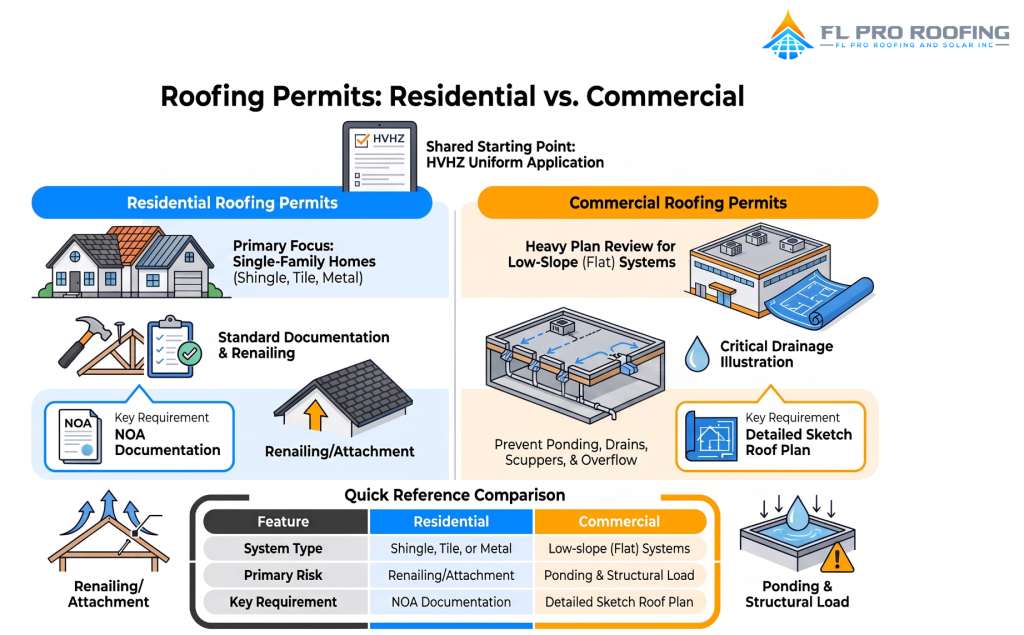 Both filings use the same HVHZ Uniform Application, but the paperwork diverges fast once you’re past the cover page.
Residential reroof permits typically cover asphalt shingle, concrete tile, or metal on single-family homes. Our residential roofing team handles the NOA documentation and renailing inspections as part of every quote, so homeowners never set foot in the permit office.
Commercial roof permits almost always involve low-slope systems, which is why they trigger heavier plan review. A sketch roof plan must illustrate all levels and sections, roof drains, scuppers, overflow scuppers and overflow drains, critical for flat commercial roofs where ponding water is a structural risk.
Our commercial roofing division manages these engineered submittals, since a rejected commercial application can stall business operations for weeks while re-review happens.
Local Climate & Neighborhood Realities Across Broward
Permit rules aren’t theoretical, they’re shaped by what actually survives a South Florida storm season.
Concrete tile remains the dominant roofing material in Broward County, particularly in communities like Weston, Plantation, and Pembroke Pines, largely due to its 40 to 50 year lifespan. Move toward the coast and preferences shift upscale: clay barrel and Spanish-profile tile is the premium choice for luxury homes in communities like Lighthouse Point, Parkland, and the waterfront estates of Fort Lauderdale’s Las Olas Isles, where the 50 to 100 year lifespan justifies the higher upfront cost.
Metal is the fastest-growing category. Metal roofing is the fastest-growing category in Broward County due to its 40 to 70 year lifespan, superior hurricane wind resistance, and significant insurance premium reductions, one homeowner in Coconut Creek’s Banyan Trails community recently switched from tile to standing seam metal for $16,500 and qualified for a Florida energy tax credit that offset $2,000 of the cost. On the commercial side, TPO and modified bitumen flat roofing is standard for residential additions, older condominiums, and commercial properties throughout Broward County, and white reflective TPO reduces cooling costs significantly in South Florida’s climate.
If your property sits near the county line, the comparison to Palm Beach is worth knowing. The average roof replacement cost in Palm Beach County is between $16,000 and $32,000 for most single-family homes in 2026, and prices run slightly higher than Broward because Palm Beach County’s permitting process is more involved and inspection timelines are longer. Homeowners in Deerfield Beach weighing a move a few blocks north should factor that gap into their budget.
Why the Permit Pays You Back: Wind Mitigation Insurance Credits
A permitted roof isn’t just compliant, it’s profitable. Once your final inspection passes, a licensed inspector can complete the state’s wind mitigation form, and Florida Statute 627.0629(1) requires every property insurer in the state to discount the windstorm portion of your premium based on what it finds.
The form itself got an update this year: as of April 1, 2026, all inspections conducted must use the new OIR-B1-1802 form, with updated discount tables and stricter documentation requirements for impact windows, roof coverings, and roof-to-wall connections. The savings are real, homeowners with several qualifying features typically save $300 to $600 per year on the windstorm portion of their premium, and homes with comprehensive wind protection can see 20 to 30% off their total annual premium. For a South Florida household already paying several thousand dollars a year in windstorm coverage, that’s not a rounding error.
The Real Cost of Skipping a Roof Permit
As detailed in the Complete Guide to Roof Replacement in Pompano Beach, FL, cutting corners on permitting is a financial risk, not a paperwork shortcut. Working without a permit can trigger a cascade of expensive problems:
- Fines and Forced Removal: The building department can issue steep fines or even force you to tear off the new roof.
- Engineering Fees: You may be required to hire an engineer to certify the unpermitted work, adding $1,500 to $4,000 or more on top of the original project cost.
- Insurance Denials: Unpermitted work often gives insurance companies grounds to deny future claims.
Resale Complications Compound
The consequences only multiply when it’s time to sell. Unpermitted roofing can delay closings by 30 to 90 days while retroactive permit processing completes. This delay frequently causes deals to fail when frustrated buyers withdraw. Furthermore, sellers face serious legal liability for non-disclosure if they leave unpermitted work off property disclosure forms.
Real-World Scenario: Imagine a homeowner near Sunrise who had a “cash job” reroof done off the books. When they list the home, the buyer’s insurer flags the unpermitted roof during a wind-mitigation inspection. This forces a retroactive engineering certification, a multi-week closing delay, and thousands in unplanned fees that a permitted job would have avoided entirely.
Storm Protection and Insurance Coverage
On the flip side, permitted work protects you after a storm. If your roof suffers damage caused by a covered event such as a hurricane, tropical storm, hail, or severe wind, your homeowner’s insurance will typically cover most or all of the replacement cost. Because Florida law requires insurers to cover roof replacement when damage exceeds a certain threshold, having a documented, permitted roof ensures you can actually utilize that protection when you need it most.
Frequently Asked Questions
1. How much does a roof replacement permit cost in Broward County?
Most residential permits run $200 to $500, while commercial permits range from $500 to $25,000 or more depending on valuation. Roofing permit fees typically range from $150 to $800 depending on the scope and municipality, with most residential reroof permits falling between $200 and $500.
2. How long does Broward County take to approve a roof permit?
Standard residential applications take 7 to 14 business days in the normal season. Broward County processes complete roof permit applications in 7 to 14 business days during normal periods and 10 to 21 days during peak season.
3. Do I need a permit to replace just part of my roof?
Yes, if the repair is structural or exceeds a certain scope. Repairs that involve structural work, material changes, or that collectively replace more than 25% of the roof within a 12-month period almost certainly require a permit.
4. Who is legally allowed to pull the roofing permit?
Your licensed roofing contractor should always pull it, not you. A homeowner may apply for a homeowner-builder permit, but doing so places all liability for damages or injury on the homeowner, so it’s recommended to hire a qualified contractor licensed by Broward County or the state of Florida.
5. How long is a Broward County roofing permit valid before it expires?
It’s valid for 180 days from issuance. Broward County permits are valid for 180 days from the date of issuance, and if work doesn’t begin within this period, the permit will expire.
6. Does a permitted roof actually lower my insurance premium?
Yes, it’s the documentation insurers are legally required to credit. Under Florida Statute §627.0629, insurance companies are required to provide premium discounts to homeowners who have verified wind-resistant construction features.
A properly permitted roof is the difference between a hurricane-rated system that protects your investment and a liability waiting to surface at your next insurance renewal or home sale. If you’re planning a reroof anywhere from Pompano Beach to Weston, reach out to our team for a same-day estimate, or find us on Google Maps to see how we’ve helped neighbors through this exact process.