Broward & Palm Beach County's Trusted Choice For Roofing Solutions
Pinpointing Roof Leaks in Pompano Beach, FL | 2026 Guide
Trusted Local Roofing for Broward & Palm Beach Counties
Schedule a Free Estimate
Roof Leak Detection in Pompano Beach, FL (2026 Guide)
When water stains suddenly bloom on your ceiling or musty odors fill the attic, your home has an active structural vulnerability. For accurate roof leak detection Pompano Beach homeowners must act fast. A dripping fixture or yellow drywall ring means water has been compromising your roof deck for weeks. The issue is no longer if you have a leak, but exactly where it originated.
Our coastal climate brings relentless salt air, tropical downpours, and wind uplift that inland properties do not experience. These harsh elements quickly deteriorate tile underlayment, split pipe boots, and lift shingles. Professional detection provides an immediate answer by utilizing advanced thermal imaging to map hidden moisture paths beneath the surface. This technology eliminates expensive guesswork and pinpoints the exact entry point.
Do not let a slow drip evolve into a catastrophic repair. Partner with the proven professionals at FL Pro Roofing & Solar to secure your property and eliminate moisture intrusion. Schedule your comprehensive thermal inspection today to permanently protect your home.
How to Tell If Your Pompano Beach Roof Is Leaking Right Now
Not every leak announces itself with a dripping ceiling. Most start as slow, hidden moisture intrusion that takes weeks or months to surface visibly by which point insulation, drywall, and framing may already be compromised.
Watch for these five specific indicators:
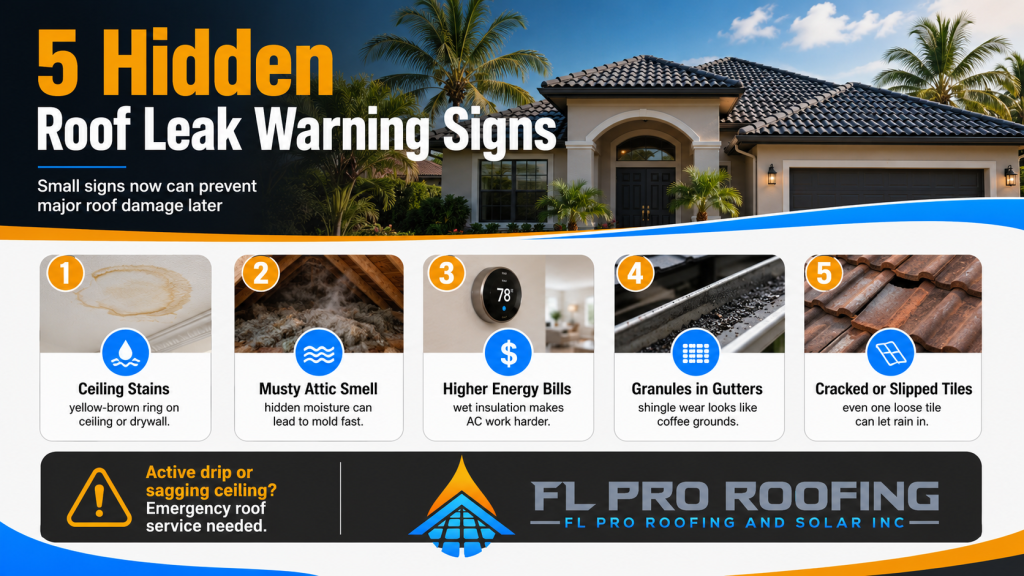
- Ceiling discoloration — a yellow-brown ring, even one smaller than a dinner plate, indicates moisture has been sitting in the drywall for at least several days.
- Musty attic odor — mold growth typically begins within 24 to 48 hours of sustained moisture exposure in a humid, poorly ventilated Florida attic.
- Rising energy bills — wet insulation loses up to 40% of its R-value, forcing your AC to work harder in Pompano Beach’s 90°F+ summer heat.
- Granule loss in gutters — a coffee-ground-like buildup signals asphalt shingles are past their protective lifespan, typically 15 to 18 years in South Florida’s UV and salt-air conditions.
- Cracked or slipped tiles visible from the ground — a single dislodged tile after a summer thunderstorm is enough to let wind-driven rain track under the roof deck.
If you’re seeing an active drip or a sagging ceiling patch, stop reading and call for emergency service, our team has a dedicated protocol for that scenario at emergency roof repair in Pompano. Everything below applies to leaks that are present but not yet an active emergency.
Why Pompano Beach Roofs Leak More Than Roofs Inland
Four regional factors combine to make leak detection a different discipline here than it is 40 miles west near the Everglades or up in Central Florida.
- The rainy season delivers volume, not just frequency. Pompano Beach’s wettest stretch runs roughly June through October, with September averaging close to 10 inches of rainfall, often falling in short, intense bursts rather than a steady drizzle. That kind of downpour finds every weak seam in a roofing system almost immediately, especially where flashing has already started to separate.
- Salt air accelerates fastener corrosion. Homes within a few miles of the Intracoastal including properties near Harbor Village, where canals lead directly out to the Intracoastal Waterway, see galvanized roofing nails and flashing corrode noticeably faster than the same materials 15 miles inland, a pattern well documented in coastal-corrosion data used across South Florida roofing manufacturing standards.
- Mixed-era roof stock creates inconsistent vulnerabilities. The Northwest Pompano neighborhood, sitting west of I-95 and north of Atlantic Boulevard, has thousands of homes built across several decades, meaning tile, shingle, and flat-roof failure points are all present within a few square miles of each other. Cresthaven, just south of Sample Road near Pompano Beach Airpark, mixes 1960s-era flat-roofed ranch homes with newer tile re-roofs, each style leaks differently and requires a different detection approach.
- UV exposure ages materials unevenly across a single roof. A south- or west-facing slope in Pompano Beach absorbs significantly more direct sun over a year than a north-facing slope on the same house, which means one side of a roof can show granule loss or tile micro-cracking years before the other side, a detail a quick drive-by inspection almost always misses.
A Real-World Example: What Hidden Leak Detection Looks Like in Practice
Imagine a typical scenario in Cresthaven: after a heavy July downpour, a faint stain appears on a bedroom ceiling. A standard visual inspection from the ground reveals absolutely nothing, with no obvious damage or missing tiles. While an average contractor might simply advise you to monitor it, the expert roofing contractors at FL Pro Roofing and Solar take a more rigorous approach.
Using advanced thermal imaging, our infrared cameras reveal a different reality. We frequently discover cooler, moisture-saturated areas hidden nearly six feet away from the interior stain. This happens because water entering through a cracked ridge tile travels laterally along the underlayment before dripping through. Without our precise thermal data, a traditional repair crew would patch the wrong location, guaranteeing the leak returns during the next storm.
This lateral-travel behavior is precisely why “we fixed it, but it still leaks” is a frequent complaint across older roofs in Broward County. Homeowners in Pompano Beach consistently trust FL Pro Roofing and Solar because our proven leak detection methods guarantee accurate, lasting solutions.
Thermal Imaging vs. Traditional Leak Detection: What Actually Works
Most “leak detection” quotes you’ll get in South Florida are really just a visual roof walk. That works for obvious damage but misses subsurface moisture entirely. Here’s the honest comparison:
Method | What It Finds | Detection Accuracy | Typical Time Onsite | Best For |
Visual Roof Inspection | Surface damage, missing tiles, obvious cracks | Low-Moderate | 20 to 30 min | Confirming visible damage after a storm |
Water Testing (hose test) | Simulates rain to trace active leak paths | Moderate | 45 to 90 min | Isolated, repeat leaks in one location |
Moisture Meter (pin/pinless) | Quantifies wetness in decking and drywall | Moderate-High | 30 min | Confirming extent of known wet areas |
Infrared Thermal Imaging | Temperature differentials from trapped moisture, even under tile or membrane | High | 45 to 60 min | Hidden leaks, multi-source leaks, pre-purchase inspections |
Infrared cameras detect surface temperature variations as small as half a degree Fahrenheit, trapped water holds heat differently than dry decking, so a thermal scan can map an entire roof’s moisture footprint in one pass instead of guessing based on interior stains alone. This is the exact method used in our Thermal Imaging Leak Detection Service, and it’s become the standard for any roof where the entry point isn’t obvious from the ground or attic.
The FL Pro Roofing Detection Process (Step-by-Step)
- Interior walkthrough (Day 1, 10 to 15 min): We document every stain, soft spot, and odor location before touching the roof, since interior damage patterns often point away from where the leak looks worst outside.
- Thermal scan of the full roof deck (Day 1, 30 to 45 min): Performed mid-morning after overnight temperature stabilization for the cleanest heat-signature contrast.
- Physical verification of flagged zones (Day 1, 15 to 20 min): Any thermal hotspot gets a hands-on check, tile lift, cracked boot, or lifted flashing, to confirm the camera’s findings rather than relying on imaging alone.
- Same-day written report with photos (within 1 hour of inspection): You get the thermal images, annotated problem zones, and a line-item repair estimate before we leave the property.
- Repair or referral (scheduled within 24 to 72 hours): Minor fixes like resealing a boot or resetting tile are often same-week; full section replacements are scheduled based on material availability.
Common Roofing Materials in Pompano Beach and Where They Leak First
Not all roofs fail the same way, which is why a one-size-fits-all inspection misses so much. Here’s what we see most often by material type:
Roof Material | Typical Lifespan (South FL) | Most Common Leak Point | Detection Difficulty |
Clay/Concrete Tile | 25 to 30 years (underlayment fails first, around year 15 to 20) | Cracked tiles, deteriorated underlayment beneath intact-looking tiles | High, leaks travel laterally before surfacing |
Asphalt Shingle | 15 to 18 years | Nail pops, granule loss, ridge cap separation | Moderate |
Flat/Low-Slope Membrane (TPO, Modified Bitumen) | 15 to 20 years | Seam separation, ponding water zones, HVAC penetrations | High, moisture travels under membrane before dripping |
Metal Roofing | 30 to 40 years | Fastener backout, ridge/valley flashing seams | Low-Moderate |
Notice that tile and flat membrane systems, the two most common types across older Pompano Beach neighborhoods are also the two hardest to diagnose visually. That’s precisely why thermal imaging has become standard practice rather than an upsell.
Commercial Flat Roof Leak Detection in Pompano Beach
Flat and low-slope commercial roofs, common along the Andrews Industrial District near NW 22nd Ave, fail differently than residential sloped roofs. Ponding water, membrane seam separation, and rooftop HVAC penetrations are the top three leak sources we find on commercial builds. Thermal imaging is especially effective here because moisture trapped under a TPO or modified bitumen membrane can travel laterally for dozens of feet before it drips through at a visible point, making a visual-only inspection almost useless for pinpointing the actual source. If you manage a commercial property, our dedicated guide on flat roof systems for Pompano Beach commercial buildings covers membrane selection and lifecycle planning in depth.
Roof Leak Detection Costs in Pompano Beach, FL (2026)
Pricing depends on roof size, accessibility, and whether thermal imaging is needed on top of a standard inspection:
- Standard visual inspection: $150 to $300
- Thermal imaging scan (residential, up to 2,500 sq ft): $350 to $650
- Thermal imaging scan (commercial flat roof): $650 to $1,500 depending on square footage
- Minor repair following detection (boot reseal, tile reset, flashing patch): $300 to $1,200
- Major repair (deck replacement section, membrane patch): $1,500 to $5,000+
Many homeowners recoup part of this cost through insurance if the leak stems from storm damage, Broward County’s Florida Building Code requires documentation of pre-existing versus storm-caused damage, which is exactly what a dated, photographed thermal scan provides for a claim. Keep in mind that most insurers require the inspection to be dated within a specific window of the storm event, so scheduling detection promptly after severe weather isn’t just about stopping the leak, it’s about protecting your claim eligibility.
Preventing Leaks Before Hurricane Season Hits

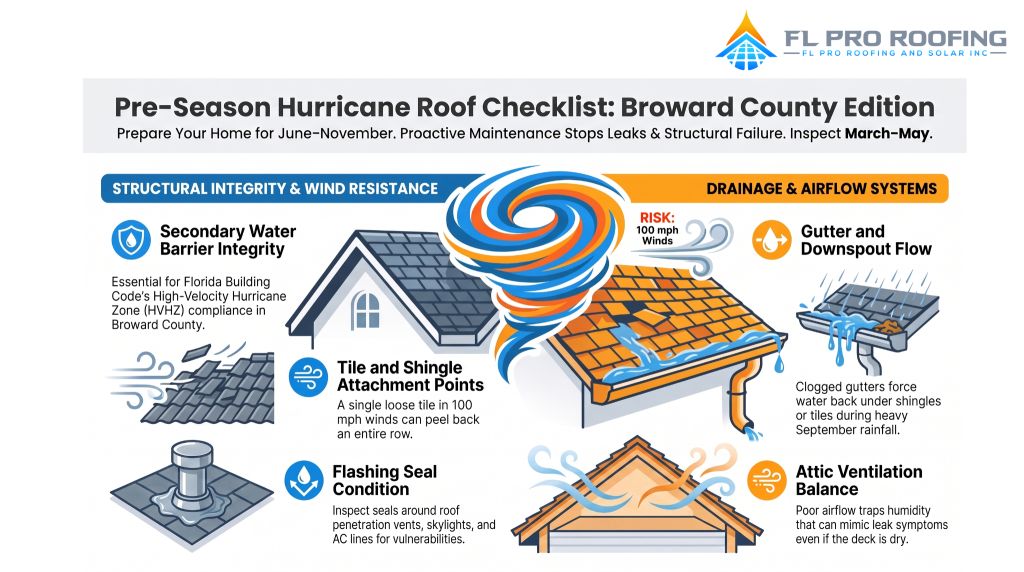
A pre-season check should specifically confirm:
Secondary water barrier integrity: Required under the Florida Building Code’s High-Velocity Hurricane Zone (HVHZ) provisions that apply to Broward County.
Flashing seal condition around any roof penetration vents, skylights, and AC lines.
Gutter and downspout flow: Clogged gutters back water up under the first course of shingles or tile during heavy September rainfall.
Attic ventilation balance: Poor airflow traps humidity that can mimic leak symptoms even when the roof deck itself is dry, which is why the interior walkthrough step in our process matters as much as the exterior scan.
Tile and shingle attachment points: A single loose tile or shingle in a 100 mph wind event can peel back an entire row before the storm passes.
Homeowners who schedule roof inspections and maintenance in this spring window typically see shorter turnaround times for any needed repairs, simply because contractor crews aren’t stretched across dozens of storm-damage emergencies at once.
Neighborhoods & Areas We Serve for Leak Detection
We run thermal imaging and leak detection calls throughout Pompano Beach and the surrounding service radius, including:
- Northwest Pompano and Cresthaven — mixed-era roofs bordering Pompano Beach Airpark
- Harbor Village and Avalon Harbor — coastal, salt-exposed roofing systems near the Intracoastal
- Old Pompano and Downtown — historic and mid-century homes near the cultural district
- Nearby suburbs: Lighthouse Point, Deerfield Beach, Coconut Creek, and Margate
If your home falls within this radius, our residential roofing team can also evaluate whether a detected leak is isolated or a sign of broader roof-system aging. Check out our comprehensive blog post, “How Much Does a Roof Inspection Cost in Pompano Beach? Visual, Thermal Imaging, and Wind Mitigation Compared,” for a complete breakdown of local costs and inspection methods.
Frequently Asked Questions
1. How much does roof leak detection cost in Pompano Beach?
Standard visual inspections run $150 to $300, while a full thermal imaging scan typically costs $350 to $650 for residential roofs. Commercial flat roofs run higher due to square footage and membrane complexity.
2. Can thermal imaging find a leak without cutting into the roof?
Yes. Infrared cameras detect the temperature signature of trapped moisture from the surface, allowing technicians to map hidden leak zones without any exploratory demolition in most cases.
3. How long does a professional leak detection inspection take?
A combined visual and thermal inspection on an average residential roof takes 45 to 90 minutes total, with a written report and photos delivered the same day.
4. Does homeowner's insurance cover roof leak detection?
Insurance typically covers the resulting damage from a covered peril, like wind-driven rain, but not the detection inspection itself. A dated thermal report does, however, strengthen a claim by documenting the leak’s timing and cause.
5. How often should Pompano Beach homeowners get a leak detection inspection?
Once a year is standard, ideally in early spring before hurricane season, plus an additional check after any storm producing sustained winds above 50 mph.
6. Why did my roof leak after a repair?
This usually means the original repair addressed the visible symptom, not the actual entry point, a common outcome with tile and flat-membrane roofs where water travels laterally before dripping through, which is why thermal verification before and after repair matters.
Take Control Before the Storm: Safeguard Your Home Today
A hidden roof leak in coastal Florida rarely stays hidden once peak summer rain hits. The real choice comes down to timing: you can either detect moisture early on your terms or face chaotic water damage during a sudden downpour. Scheduling expert roof leak detection Pompano Beach homeowners trust ensures that minor cracks, underlayment gaps, or worn flashing are identified before they turn into costly interior repairs.
Proactive thermal imaging inspection isolates vulnerabilities accurately, giving you complete clarity and immediate options. Do not wait for a collapsing ceiling or emergency repair bills to force your hand. Partner with FL Pro Roofing & Solar today to safeguard your home against severe weather. Claim your free estimate now and secure your property before the next storm rolls through.
