Broward & Palm Beach County's Trusted Choice For Roofing Solutions

Roof Replacement Cost in South Florida: 2026 Pricing Guide

Trusted Local Roofing for Broward & Palm Beach Counties

Schedule a Free Estimate

Name
Address

The Honest 2026 Guide to South Florida Roof Pricing

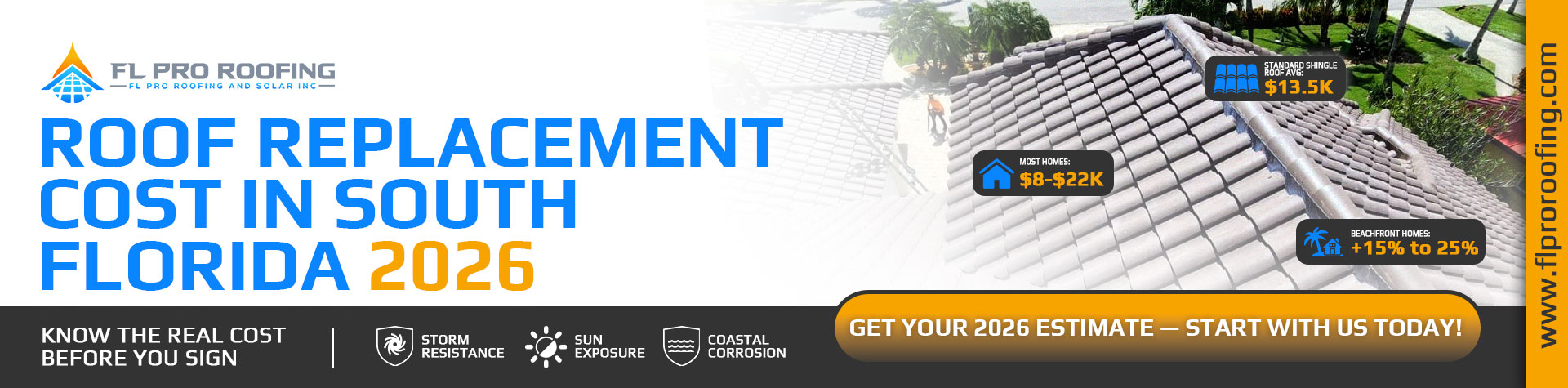
Roof replacement cost South Florida 2026 banner by FL Pro Roofing showing K-2K average price and service factors.

Replacing an aging roof is highly stressful when you are facing unpredictable storms and confusing estimates. To cut through the noise, the typical roof replacement cost South Florida homeowners will pay in 2026 ranges between $8,000 and $22,000. An average architectural shingle job lands around $13,500. In Pompano Beach, expect $10,500 to $21,000 for a standard home, with beachfront properties adding an extra percentage for marine-grade components.

This price range exists because our tropical environment is uniquely punishing. Every roof here constantly battles hurricane-force winds, intense UV degradation, and coastal salt air. Having served Broward and Palm Beach counties since 1997, we have watched pricing shift with material demands, insurance mandates, and rigorous code updates. This year brings crucial regulatory changes you must understand before signing any paperwork.

Do not let a compromised roof threaten your biggest investment. Protect  your property with a premium, weather-tested system by booking your expert roof replacement with FL Pro Roofing & Solar today.

2026 Roof Replacement Cost by Material (Comparison Table)

Material

Cost Per Sq. Ft. Installed

Total Cost (2,000 sq ft home)

Typical Lifespan

Best For

Architectural Asphalt Shingle

$5.50 to $9

$10,500 to $18,000

20 to 30 years

Budget-conscious homeowners, inland properties

Concrete Tile

$11 to $16

$22,000 to $32,000

40 to 50 years

Palm Aire, Cresthaven, and classic South Florida communities

Clay Tile

$15 to $22

$30,000 to $44,000

75+ years

Long-term owners wanting maximum durability

Metal Standing Seam

$12 to $23

$18,000 to $32,000

40 to 70 years

Coastal properties near the Intracoastal, insurance-discount seekers

These figures reflect installed pricing, meaning tear-off, disposal, permitting labor, and standard underlayment are already baked in. A bare “material only” quote that looks dramatically cheaper than these ranges is almost always missing something, usually the permit fee, the secondary water barrier, or proper flashing at penetrations.

Why Broward & Palm Beach Homeowners Pay More Than the National Average

The HVHZ Factor

This is the single biggest driver of your quote, and it’s the detail most national cost calculators completely miss. Broward County sits inside a designated High-Velocity Hurricane Zone (HVHZ) under the Florida Building Code, a classification that applies to Miami-Dade and Broward Counties specifically, meaning every city within Broward, Pompano Beach included, falls under some of the strictest roofing installation standards in the country. This isn’t based on how close your street is to the ocean. Every shingle, tile, fastener, and flashing component on your new roof needs product approval documentation (an NOA, or Notice of Acceptance) before it can legally go on your house.

Palm Beach County handles this a little differently, and it’s worth understanding if you’re comparing quotes across county lines. Cities like Boca Raton voluntarily apply HVHZ-equivalent review standards, but Pompano Beach operates under the actual mandatory HVHZ code by law. That distinction shows up in your final invoice, a quote for a home near Boca’s Mizner Park may use slightly different fastening schedules or underlayment specs than one in Pompano, even though both properties sit within “South Florida.”

Permits & Inspections

Broward County building permits typically add $400 to $900 to the total cost of your project, and this line item is non-negotiable. Every roof replacement in Broward County requires a building permit, and a licensed contractor should pull it under their own license to protect you legally and ensure the job passes final inspection. In Pompano Beach specifically, the permit and NOA documentation review often runs on its own timeline before crews can even begin tear-off. Plan for this if your roof is actively leaking and you’re on a tight schedule.

Deck Condition & Structural Surprises

This is where estimates go sideways, and it’s the number one reason a “final bill” ends up higher than the original quote. Tear-off frequently reveals structural issues homeowners never knew existed like undersized rafters, deteriorated plywood decking, missing or improperly fastened hurricane straps, and soffit or fascia rot hiding behind trim. If your home was built before 1990 (common throughout Cresthaven, Garden Isles, and Cypress Lakes), budget a contingency for this. Rotted or damaged deck boards typically add $2 to $5 per square foot to replace, and a full deck replacement on a mid-size home can add $3,000 to $6,000 to the project total.

Roof Pitch, Layers, and Complexity

Most Broward County homes range from 18 to 30 roofing squares (a “square” equals 100 sq ft), and steeper pitches require more labor time, additional safety harnessing, and slower material staging, all of which show up directly in your labor line item. If your current roof already has two layers of shingles on it, expect a higher tear-off cost too, since removing two layers takes roughly 40% longer than a single-layer tear-off and generates significantly more debris for disposal.

Hidden Costs Homeowners Often Miss

An infographic showing the hidden cost when you are replacing roof that homeowners often miss.

Beyond the “big four” factors above, a handful of smaller line items catch homeowners off guard nearly every time:

  • Secondary water barrier (SWB): Current Florida code effectively requires a self-adhered underlayment layer beneath the primary roof covering in HVHZ jurisdictions. Expect $0.75 to $1.50 per sq ft added to the project.
  • Drip edge and flashing upgrades: Older homes often have undersized or corroded flashing around chimneys, skylights, and wall intersections. Replacing this properly adds $300 to $900 depending on penetration count.
  • Ventilation corrections: Many older Pompano homes are under-ventilated by today’s standards. Adding ridge vents or additional soffit venting typically runs $400 to $1,200 and directly affects attic temperature and shingle lifespan.
  • Debris disposal and dumpster fees: Tile tear-off generates significantly more weight and volume than shingle removal, and disposal fees for a full tile roof can run $800 to $1,500 versus $300 to $600 for shingle.
  • Gutter and downspout reattachment: If gutters need to come down for proper drip edge installation, reattachment or minor gutter repair adds $200 to $500.


None of these are upsells, they’re code-driven or climate-driven necessities. A contractor who quotes suspiciously low and doesn’t mention these items is either planning to cut a corner or planning a change order mid-project.
Material-by-Material Guide for Pompano Beach's Coastal Climate

Architectural Asphalt Shingles

When choosing a residential roof in South Florida, architectural asphalt shingles are the most common choice for inland Broward neighborhoods and the entry point for most homeowners. Architectural shingles typically last 20 to 30 years in Florida’s climate, though constant UV exposure and humidity tend to push actual performance toward the lower end of that range compared to cooler northern states. For homes east of Federal Highway, we recommend upgrading to Class 4 impact-resistant shingles. The salt exposure and storm frequency alone justify the extra $2 to $3 per square foot, and many insurers offer premium credits for the upgrade.

Concrete & Clay Tile

Tile is practically synonymous with South Florida curb appeal, and it’s the dominant material in communities like Palm Aire. Palm Aire is one of the largest residential communities in Pompano Beach, a sprawling golf-course community built starting in the 1970s, and the original roof systems there are now 40 to 50 years old, meaning even homes re-roofed once already in the 1990s or early 2000s are now sitting back inside the replacement window.

Clay outperforms concrete in raw longevity, often lasting 75 years or more with wind resistance ratings up to 140 mph, but concrete remains the value pick for most families because it delivers similar aesthetics at roughly two-thirds the cost.

Metal Standing Seam

Metal has become the fastest-growing category along the coast, and for good reason. It combines a 40 to 70-year lifespan with superior wind uplift resistance and, in many cases, meaningful insurance premium reductions once the wind mitigation inspection is filed. One recent project in Coconut Creek’s Banyan Trails community involved a homeowner switching from aging tile to standing seam metal for $16,500, a move that also qualified for a federal energy efficiency tax credit thanks to the reflective coating.

If your property sits near the Intracoastal or within a half-mile of Harbor Village, this matters even more, standard galvanized fasteners can fail within 3 to 5 years in that salt-air environment, so marine-grade stainless steel fasteners aren’t an upsell; they’re the only responsible choice for that location.

Labor vs. Material: Where Your Money Actually Goes

Homeowners often assume shingles or tiles themselves make up most of the bill. In reality, on a typical HVHZ-compliant re-roof, the split looks closer to this:

Cost Category

Approx. % of Total Project

Materials (shingles/tile/metal, underlayment, fasteners)

40 to 45%

Labor (tear-off, install, cleanup)

30 to 35%

Permits, inspections, NOA documentation

5 to 8%

Deck repair contingency

5 to 15% (variable)

Disposal & dumpster fees

3 to 6%

This is why two quotes with “identical” shingles can differ by $2,000 or more, the gap almost always lives in labor crew size, permit handling, and how much deck repair contingency is baked in versus treated as a surprise change order later.

A Real-World Example: Re-Roofing a Palm Aire Home

Here’s how a typical 2026 project played out for a 2,100 sq ft single-story home near Palm Aire Country Club, originally roofed with concrete tile back in 1994:

  1. Inspection & tear-off decision (Day 1): With the original roof at 32 years old, our crew found more than 25% of the tile field had failed underlayment. Under Florida Building Code’s 25% rule, once damage or deterioration exceeds that threshold within a 12-month period, the entire roof system must come into full HVHZ compliance, a patch job wasn’t legally an option anymore.
  2. Deck repair (Day 2): Tear-off revealed 8 sheets of rotted plywood decking, adding roughly $1,600 to the original estimate.
  3. Material selection: The homeowner chose concrete tile to match neighborhood architectural guidelines rather than switch materials, avoiding an HOA design review delay that can add 2 to 4 weeks to a project timeline.
  4. Permit & NOA approval: The Pompano Beach permit process for this HVHZ jurisdiction ran a standard 2 to 3-week timeline, with a secondary water barrier required under current code.
  5. Final cost: $27,400 total — landing squarely inside the $22,000 to $32,000 concrete tile range, with the deck repair pushing it toward the higher end.


The lesson here isn’t unique to this one house. It’s the same pattern we see across older Broward neighborhoods every month: the roof itself is rarely the surprise, the deck underneath it usually is.

5 Ways to Lower Your Roof Replacement Cost Without Cutting Corners

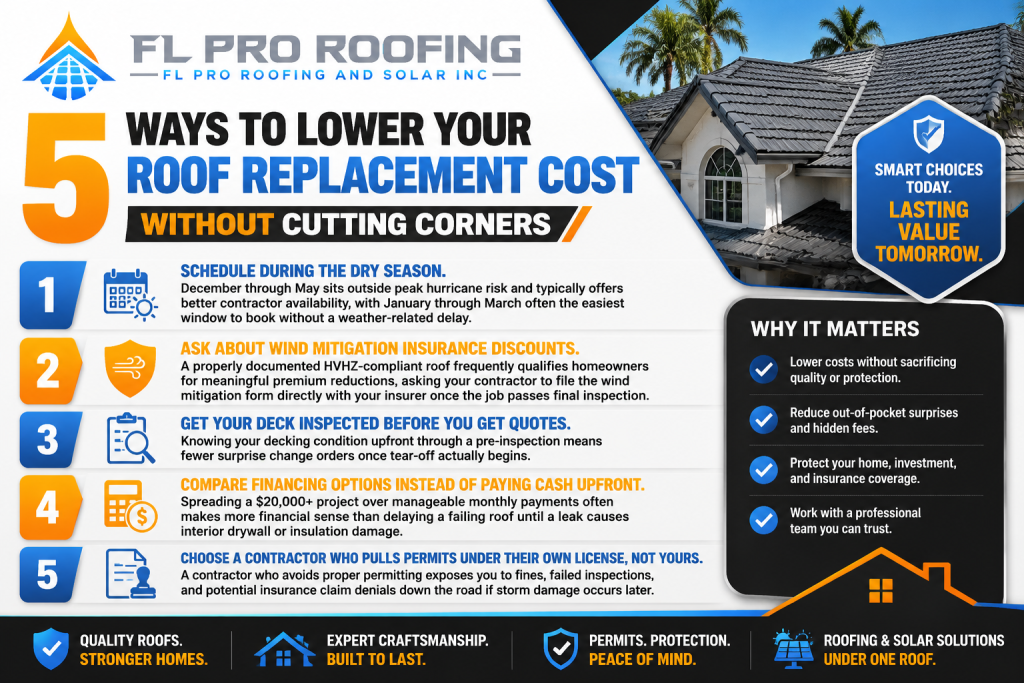
Infographic on 5 ways to lower roof replacement costs by FL Pro Roofing.

  1. Schedule during the dry season. December through May sits outside peak hurricane risk and typically offers better contractor availability, with January through March often the easiest window to book without a weather-related delay.
  2. Ask about wind mitigation insurance discounts. A properly documented HVHZ-compliant roof frequently qualifies homeowners for meaningful premium reductions, asking your contractor to file the wind mitigation form directly with your insurer once the job passes final inspection.
  3. Get your deck inspected before you get quotes. Knowing your decking condition upfront through a pre-inspection means fewer surprise change orders once tear-off actually begins. If you are unsure what to expect for this step, check out our recent blog, How Much Does a Roof Inspection Cost in Pompano Beach? Visual, Thermal Imaging, and Wind Mitigation Compared,” for a complete breakdown of inspection types and pricing.
  4. Compare roof financing options instead of paying cash upfront. Spreading a $20,000+ project over manageable monthly payments often makes more financial sense than delaying a failing roof until a leak causes interior drywall or insulation damage.
  5. Choose a contractor who pulls permits under their own license, not yours. A contractor who avoids proper permitting exposes you to fines, failed inspections, and potential insurance claim denials down the road if storm damage occurs later.

Choosing a Licensed Contractor Serving Pompano Beach, Deerfield Beach & Boca Raton

Not every roofer working in South Florida understands the nuance between a standard Florida Building Code job and true HVHZ compliance. We’ve built our residential roofing services around exactly that distinction, handling everything from shingle, metal, and tile installations to the permit paperwork that trips up out-of-town crews unfamiliar with Broward’s specific requirements.

Since 1997, we’ve replaced roofs throughout Palm Aire, Cypress Lakes, Garden Isles, Harbor Village, Cresthaven, Deerfield Beach, Margate, Coconut Creek, and every corner of Broward and Palm Beach Counties, working out of our shop at 2141 NW 22nd Ave in Pompano Beach. If you’d like to see what actual neighbors are saying about our crews, take a look at our reviews on Google before you book an estimate.

Frequently Asked Questions

Most homeowners in Broward and Palm Beach counties pay between $10,000 and $25,000 for a full roof replacement in 2026, depending on material choice, roof size, and deck condition. Tile and metal run higher; asphalt shingle stays on the lower end.

Insurance typically covers roof replacement only when damage stems from a covered event like a hurricane, hail, or wind, not from age-related wear. A wind mitigation inspection can also reduce your annual premium once the new roof passes.

Most single-family homes take 1 to 3 days for tear-off and installation, though tile roofs on larger or multi-story homes can take 3 to 5 days depending on complexity and weather delays during hurricane season.

Yes. Every roof replacement in Broward County legally requires a building permit because the entire county sits inside the High-Velocity Hurricane Zone. Your contractor should pull this permit under their own license, not yours.

Clay tile and standing seam metal offer the longest lifespans in Pompano Beach’s coastal environment, often exceeding 40 to 75 years when installed with marine-grade fasteners and HVHZ-compliant underlayment near the Intracoastal.

Quotes typically increase after tear-off when crews discover rotted decking, damaged trusses, or missing hurricane straps hidden beneath the old roofing, issues impossible to see until the surface layer is fully removed.

Navigating Your South Florida Roofing Investment

Navigating your roof replacement cost South Florida project requires balancing local building codes, material durability, and proper timing. From choosing wind-resistant materials like standing seam metal or tile to scheduling during the dry season, every decision impacts your final investment. Taking advantage of wind mitigation credits, getting a deck inspection upfront, and hiring a licensed contractor who pulls proper permits will protect both your home and your wallet from unexpected surprises.

Please keep in mind that actual roof replacement costs across Florida vary based on home size, roof pitch, chosen materials, and specific local permitting requirements. Ready to protect your biggest asset before the next major storm hits? Guarantee your peace of mind by booking your expert roof replacement with FL Pro Roofing & Solar today.

(954) 803-7493